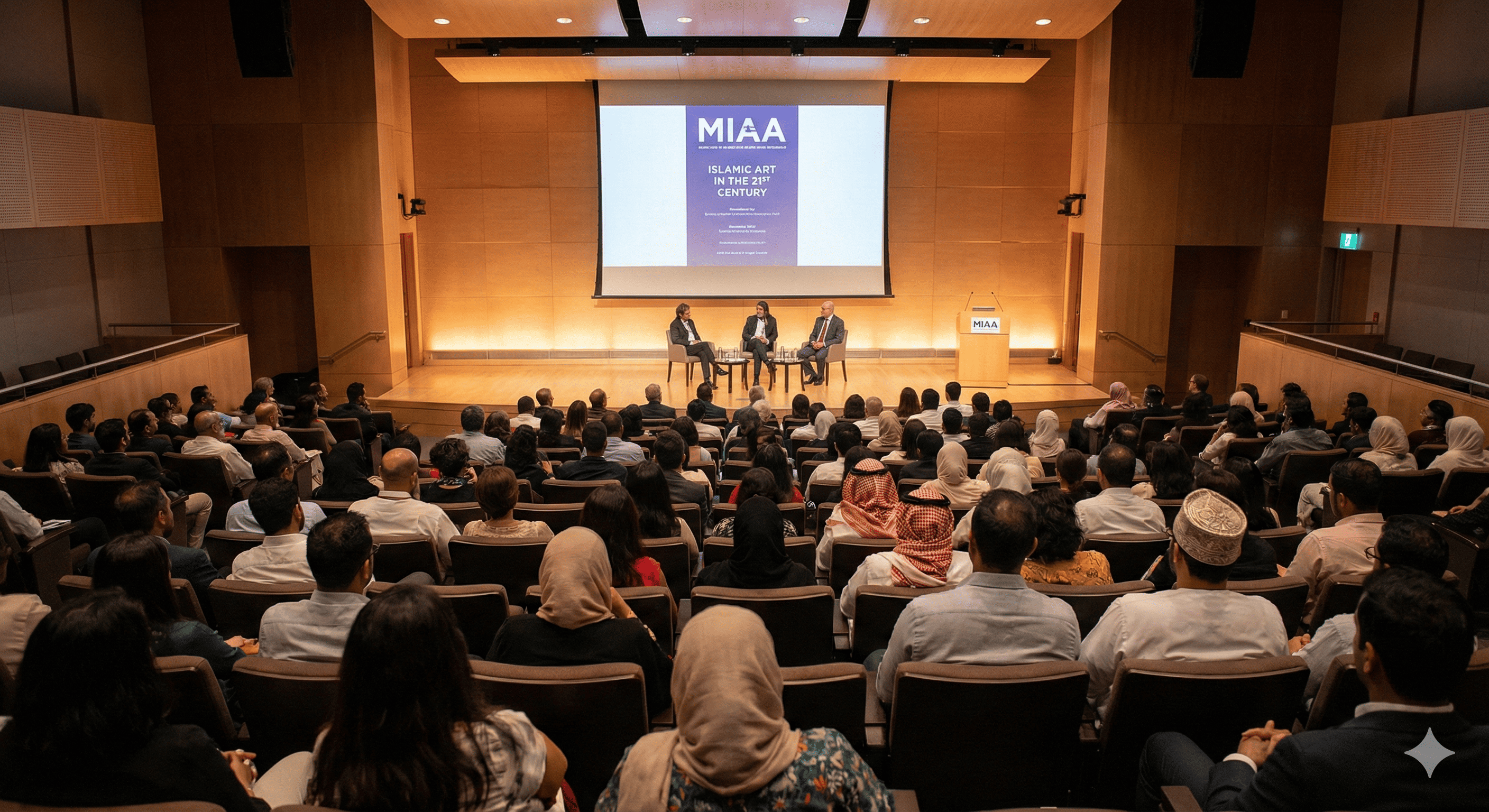
Last Saturday, MIAA welcomed a full house for an afternoon of thought-provoking discussion as three distinguished scholars examined the enduring influence of Islamic science on the modern world.
The event, titled From Baghdad to the World: The Scientific Legacy of Islamic Civilisation, brought together Dr Layla Hakim from the University of Sydney, Professor Ahmed Zewail from Western Sydney University, and Dr Rania Mahmoud, a visiting historian from the University of Edinburgh.
Dr Hakim opened with an exploration of the House of Wisdom in Baghdad, the legendary centre of learning established during the Abbasid Caliphate. She described how scholars of diverse faiths gathered there to translate Greek, Persian, and Indian texts into Arabic, creating a foundation for centuries of scientific advancement.
Professor Zewail followed with a focus on mathematics and astronomy. He traced the origins of algebra to the work of Al-Khwarizmi, whose name gives us the word "algorithm." He also highlighted the contributions of astronomers like Al-Battani, whose calculations of planetary movements influenced Copernicus centuries later.
Dr Mahmoud concluded with a discussion on the transmission of knowledge into medieval Europe. She challenged the audience to reconsider the so-called European Renaissance as a moment built substantially on Islamic scholarship—translated into Latin in cities like Toledo and Sicily, where Muslim, Christian, and Jewish scholars worked side by side.
A lively question-and-answer session followed. Audience members asked about the role of women scholars in early Islamic academies, the preservation of manuscripts today, and how this history can be better reflected in Australian school curricula.
The afternoon closed with an invitation for attendees to visit our Luminaries of the Golden Age exhibition, which brings many of the scientific instruments discussed during the panel to life.
MIAA extends warm thanks to our speakers and to everyone who joined us. Events like this reflect our mission to foster understanding, curiosity, and connection through Islamic art and history.
Stay tuned for announcements about our next lecture series, coming later this year.






.jpg)
%20(1).jpg)
%20(1).jpg)